Tell us about the job
Takes about a minute. No obligation.
A contractor diagnosing a central AC failure in Butler County starts with the system's maintenance record and the age of its components, because those are what the repair evidence points back to. 57 severe weather events were recorded in Butler County, Alabama between 2015 and 2024. At that rate, severe weather visits this area but does not define it, and a compressor or capacitor that gives out here has almost certainly worn down from years of deferred service rather than accumulated storm stress. A contractor who skips the maintenance history and jumps to weather as an explanation is skipping the likelier answer.
Half the homes in Butler County, Alabama were built in 1979 or earlier (2020-2024 ACS 5-year). Central AC units running in houses that old have logged a kind of cumulative load that shows up specifically inside the equipment: capacitors that read marginal on a meter, contactors worn past their rated cycles, evaporator coils carrying corrosion that a surface inspection misses entirely. A contractor opening a system in stock this vintage finds conditions built up over a long service life, and the repair scope follows from what those components actually measure, not from the call that brought the technician out.
The Parts of a Central AC a Contractor Checks First
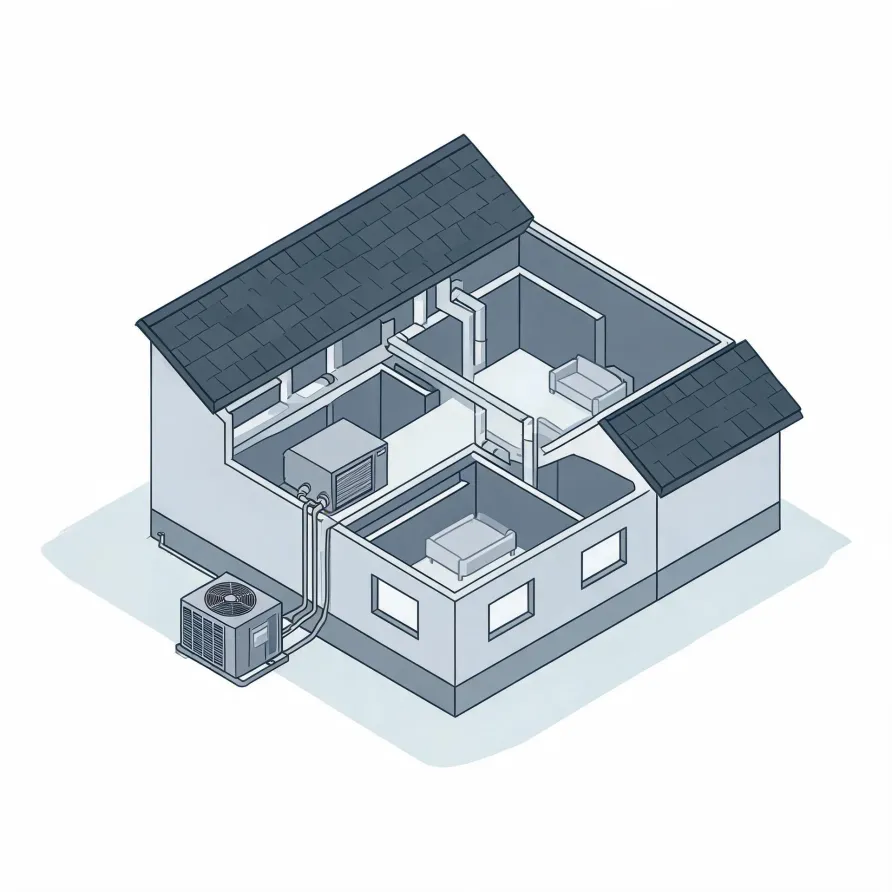
The outdoor condenser unit sits on a pad beside the house and is usually the first thing a contractor looks at when the system stops cooling. Inside the condenser, the compressor and the condenser coil do the core work, and failures in either one show up fast: no cooling at all, warm air from the vents, or a unit that runs but does nothing.
Inside the house, the air handler holds the evaporator coil and the blower. The evaporator coil is where refrigerant does its work, and a frozen coil or a refrigerant leak points directly to it. The blower moves conditioned air into the supply side of the duct system, and a failed blower motor means air simply stops moving.
The drawing shows the general layout of a central AC system, and a licensed contractor determines which components apply to your specific house and situation.
Get matched in Butler CountyButler County, by the numbers
57 severe weather events were recorded in Butler County, Alabama between 2015 and 2024.
NOAA National Centers for Environmental Information, Storm Events Database, bulk CSV export, events 2015-01-01 through 2024-12-31.Half the homes in Butler County, Alabama were built in 1979 or earlier (2020-2024 ACS 5-year).
U.S. Census Bureau, 2020-2024 American Community Survey 5-Year EstimatesButler County, Alabama holds 9,885 housing units (2020-2024 ACS 5-year).
U.S. Census Bureau, 2020-2024 American Community Survey 5-Year EstimatesOwners occupy 65.8% of the occupied homes in Butler County, Alabama (2020-2024 ACS 5-year).
U.S. Census Bureau, 2020-2024 American Community Survey 5-Year EstimatesCodes & Standards Governing Central AC Repair in Butler County, Alabama9 sourced rules and standards
What HVAC Repair Looks Like in Butler County
Split-system central air conditioners rated below 45,000 Btu/h manufactured on or after January 1, 2023 must meet a federal minimum of 13.4 SEER2.
Split-system central air conditioners rated at or above 45,000 Btu/h manufactured on or after January 1, 2023 must meet a federal minimum of 13.4 SEER2.
Split-system central air conditioners manufactured between January 1, 2015 and December 31, 2022 had to meet 13 SEER, the metric that preceded SEER2.
Single-package central air conditioners manufactured on or after January 1, 2023 must meet a federal minimum of 13.4 SEER2.
Space-constrained central air conditioners manufactured on or after January 1, 2023 must meet a federal minimum of 11.7 SEER2.
Federal efficiency standards for split-system central air conditioners and heat pumps are set on each certified combination of outdoor unit and indoor coil rather than on the outdoor unit alone.
Residential and light commercial air conditioning and heat pump systems assembled in the field, including mini-splits and unitary systems, may not be installed on or after January 1, 2025 using a refrigerant with a global warming potential above 700.
A field-assembled system whose specified components were all manufactured or imported before January 1, 2025 carries no installation compliance date under the refrigerant restrictions and may still be installed.
Licensing Rules for HVAC Repair in Butler County, Alabama
Alabama requires state certification to do heating, air conditioning and refrigeration contracting: nobody may advertise, bid, pull permits or do the work unless the person in responsible charge is a certified contractor.
Severe Weather Events in Butler County
Storms put hours on HVAC equipment fast, driving the kind of stress that turns small faults into full failures. How hard that load runs in Butler County shapes what repair work looks like here.
57 severe weather events, 2015–2024. Source: NOAA National Centers for Environmental Information, Storm Events Database.